
Category: Scholarship
When I use a word
Over on Slaw, I’ve written a rant, and posted it, too, about yet another judge’s problematic use of “substantial connection” when seemingly discussing the meaning of factual causation in the Canadian law of negligence.
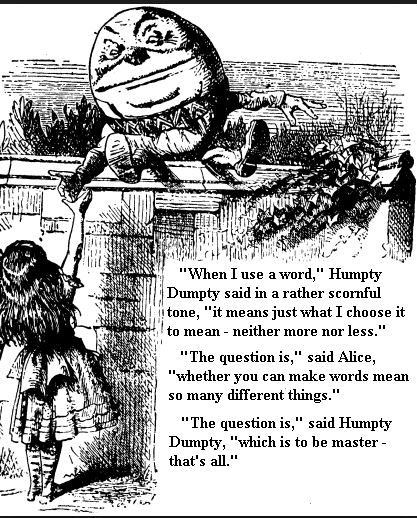
This one isn’t about a B.C. decision. The context is a motion by a defendant, in an Ontario action, to dismiss the action. The motion – an application for B.C. types – failed. I think it’s a safe assumption that the motion judge isn’t a regular reader of this blog, let alone a follower. Besides, the Rockies are in the way.
(Image from taken from a public domain version of the text of Lewis Carroll’s “Through The Looking Glass”. You’ll find it in c. 6.)
More adventuring with scholars, philosophers, and me
The truth about factual causation issues in most personal injury actions is that, where there’s any issue at all, it’s not one that involves difficult questions of law or any need to venture into realms of philosophy or metaphysics, abstract, concrete or something else. Instead, the issue is whether the evidence is enough to establish that the alleged negligence was a sufficient legal cause of the injury. The evidence may be complicated. The decision may require the trier-of-fact, judge or jury, to make difficult choices, such as who to believe or what conflicting evidence to accept or reject. In the not-trite aphorism that lawyers involved in the dispute resolution portion of the legal system soon learn, the law in a particular case is clear. What isn’t clear is how to apply the law to the facts.
I’m going to mention a 4 articles published in the last 3 years which should interest members of the legal profession, and others, who, for whatever reason, are interested the subject of causation in negligence. These articles may help to clarify, for some readers, some of the murkiness in the current state of Canadian common law case-law governing proof of factual causation in negligence actions.
Don’t worry, I’m not the author of any of them. That means the articles are short enough for convenient reading. Three of the articles are by leading academic lawyers. The fourth is by a lawyer with experience in the Canadian civil litigation, medical malpractice, trenches.
The articles are:
Jane Stapleton, “Unnecessary Causes” (2013) 129 LQR 39.
René Brewer, “The End of Material Contribution to Injury (2013) 42 Adv Q 217.
Jane Stapleton, “An ‘Extended But-For’ Test for the Causal Relation in the Law of Obligations” (2015) Oxford Journal of Legal Studies.
Oxford J Legal Studies (2015)
doi: 10.1093/ojls/gqv005
First published online: March 7, 2015
Ernest Weinrib “Causal Uncertainty” (2015) Oxford Journal of Legal Studies.
Oxford J Legal Studies (2015)
doi: 10.1093/ojls/gqv020
First published online: July 2, 2015
Unless you know somebody, the last 2 are currently available online, only.
I discuss these articles, and their significance to Canadian jurisprudence, after the break. Most of the discussion deals with Professor Weinrib’s article.
Warning: the entire post is about 6,400 words according to Word, but the wording counting tool in the version of Word I’m using counts parts of citations as words, so there’s a bit less than that.
Did the trial judge mean “necessary”? Probably, but …
Some of you may consider what follows excessive pedantry because you’ve already realized where I’m going and are horse-fanciers and members of an SPCA-type organization whose purview extends to dead animals (or zombies).
In Clements v. Clements, [2012] 2 SCR 181, 2012 SCC 32, the Supreme Court set out the requirements of the but-for test for proof of factual causation in negligence. The Court made it explicitly clear that the test turns on the requirement of “necessity”. The defendant’s negligence must have been necessary for the occurrence of the accident, and ultimately the plaintiff’s injury. Any causal relationship less than necessity will not satisfy the but-for test.
“[8] The test for showing causation is the “but for” test. The plaintiff must show on a balance of probabilities that “but for” the defendant’s negligent act, the injury would not have occurred. Inherent in the phrase “but for” is the requirement that the defendant’s negligence was necessary to bring about the injury ― in other words that the injury would not have occurred without the defendant’s negligence. This is a factual inquiry. If the plaintiff does not establish this on a balance of probabilities, having regard to all the evidence, her action against the defendant fails.”
(Emphasis in original.)
Everything in Clements after paragraph 8, dealing with the but-for test, explains how the test is to be applied; what the judge or jury is to do in order to decide if the evidence permits the valid conclusion that, on the balance of probability, the negligence was “necessary” . The discussion does not lessen, reduce – choose any synonym you want – the “necessity” requirement.
This isn’t just me on a soapbox.
In Ediger v. Johnston, [2013] 2 SCR 98, 2013 SCC 18, the Court summarized the Clements message.
[28] This Court recently summarized the legal test for causation in Clements v. Clements, 2012 SCC 32 (CanLII), [2012] 2 S.C.R. 181. Causation is assessed using the “but for” test (Clements, at paras. 8 and 13; Resurfice Corp. v. Hanke, 2007 SCC 7 (CanLII), [2007] 1 S.C.R. 333, at paras. 21-22). That is, the plaintiff must show on a balance of probabilities that “but for” the defendant’s negligent act, the injury would not have occurred (Clements, at para. 8). “Inherent in the phrase ‘but for’ is the requirement that the defendant’s negligence was necessary to bring about the injury — in other words that the injury would not have occurred without the defendant’s negligence” (para. 8 (emphasis deleted)).
After the break, I discuss I recent case in which I think the trial judge, and the plaintiff’s expert, probably meant there was a necessary relationship between the negligence and the accident, but the trial judge did not explicitly quote or paraphrase paragraph 8 of Clements. The expert’s testimony, as set out in the reasons, also does not necessarily contain any of the magic words or an explicit synonym (word or phrase).
The trial judge’s summary of his conclusion on causation was: “I am satisfied that the defendant’s negligence was a contributing cause of the accident.” (para. 33)
Did the trial judge mean: I am satisfied that the defendant’s negligence was necessary for the occurrence of the accident in the sense that, but-for the negligence of the defendant, the accident would not have occurred.
O. Henry?
The hallmark of an O. Henry story is its surprise ending.
Not a matter of tomayto or tomahto – Causation In Tort III
Because something that’ll occur on May 5, 2015, in Vancouver B.C., may begin to eliminate the problem, I’ll return to a point I’ve made a number of times, on this site, over the past 3 years.
In Clements v. Clements, [2012] 2 SCR 181, 2012 SCC 32 (see para. 8) and then in Ediger v. Johnston, [2013] 2 SCR 98, 2013 SCC 18 (see para. 28), the S.C.C. stated expressly that the causal relationship between negligence and injury described by the but-for test is one of “necessity” established on the balance of probability. Notwithstanding that, it is still very common – too common – to find statements in reasons for judgment of British Columbia Supreme Court judges which statements, taken at face value, assert a different meaning even when one or both of Clements and Ediger are cited. (Sometimes neither are. Something else, older, is. Really. That’s a different problem.)
I’ve also written that, in at least some of the reported decisions, one can’t tell – or at least I can’t tell – from the text of the reasons what meaning of “but-for” the trial judge applied in deciding that the required causal relationship existed. Perhaps the trial judge did apply the necessity meaning. Perhaps the evidence required that conclusion even if the judge didn’t decide the causation issue that way. However, I’ve suggested that one can’t tell from the reasons. If I’m right, that’s not, all things considered, a “good thing”, even if does create the possibility of more work for lawyers.
I had decided, honouring the “if one can’t say anything good … ” mantra, to stop complaining, at least on this site, about that tendency in reported BCSC reasons. However, I’ve decided that it’s worth mentioning the accurate summary in a very recent Supreme Court of Ontario decision and two more of the erroneous (in my view) summaries in BCSC decisions.
I’m not going to include quotations. I’ll provide hyperlinked citations.
Suwary v Librach, 2015 ONSC 2100 starting at para. 68
Matias v. Lou, 2015 BCSC 544 starting at para. 21
Singh v. Wu, 2015 BCSC 526 starting at para. 78
For those not inclined to clink on links as they read, the something that’ll occur is the Continuing Legal Education Society of British Columbia’s programme Causation in Tort III.
 The 4th Monkey Still in Abstenia